Posts Tagged With: #orlandohistory

The Round Building, Orange Ave and South St

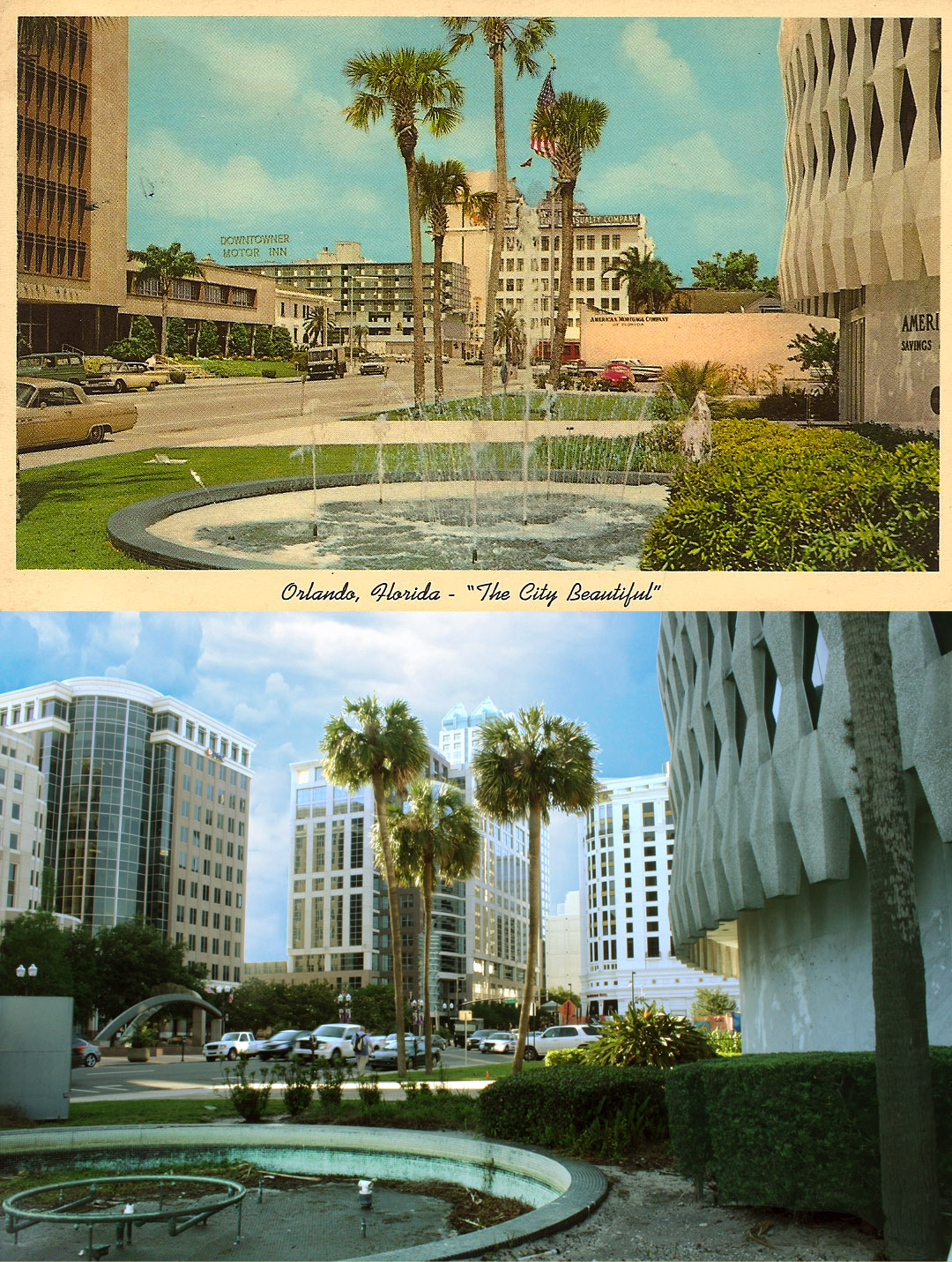
Looking North on Orange Avenue at South Street Intersection 1960's and 2013

Looking North on Orange Avenue at South Street Intersection
1960’s and 2013

The Postcard

The view looking north up Orange Avenue is framed by city hall on the left and the mid-century modern American Federal Savings and Loan building (AKA The Round Building). Tall palm trees center the postcard, behind them are the Downtown Motor Inn, Sun Bank and the American Fire & Casualty Insurance buildings.

The view today looks similar to the 1960’s postcard even though all but one of the buildings in the postcard have been demolished. City hall was replaced with our current city hall. SunBank – now SunTrust – rebuilt near the same spot. The Downtowner and the American Fire & Casualty buildings are long gone. Now the Grand Bohemian sits on the corner. And at least for today, the former American Federal Savings is the only remaining building.

The Round Building (American Federal Savings and Loan Association)

Today: Dr. Phillips Performing Arts Center under construction behind the Round Building.

Today: Dr. Phillips Performing Arts Center under construction behind the Round Building.

In 1961, American Federal Savings and Loan Association purchased 60,000 square feet of property across from City Hall for $400,000. At the time, there were still some homes along this stretch of Orange Ave. A few houses and a four-unit apartment building were on the site when the bank bought the land. The close proximity to Lake Lucerne probably made this a very livable area, which would not be true today with the 408 Express overhead.

Robert Murphy, a local Harvard educated architect who later founded HuntonBrady Architects, designed the building. HuntonBrady continues to design buildings today. Their credits include Team Disney, The Mennello Museum of American Art, and the Orange County Convention Center expansion. Mr. Murphy designed the bank as a round building encircled in decorative concrete panels (the bris de soleil). It was originally built at only two stories. With equally important east and west entrances, the round design helped keep an even traffic flow. A head teller from the bank had the idea for a semi circular teller counter being the most efficient way to serve customers. A skylight in the center added natural light to the bank lobby. When it first opened, the bank created further attraction by putting $1 million in bills on display in the lobby.

American Federal Savings and Loan

American Federal Savings and Loan in the early 1960’s before the additional floors were added.

In the early 70’s, additional glass enclosed stories were added to the building. This changed the appearance to a sort of office tower rising from the decorative concrete. Visual Ephemera recently quoted Mr. Murphy’s wife as stating he was not fond of the added floors.

Left: Bris de Soleil panels being installed in 1960's. Right: First panel being removed in 2013

Left: Bris de Soleil panels being installed in 1960’s.
Right: First panel being removed in 2013

The days are numbered for The Round Building. Today, three old palms tower over the dry fountain at the west entrance. It will be demolished to make room for the Dr. Phillips Performing Arts Center currently under construction. There are efforts underway to remove and repurpose the exterior panels. One section of the bris de soleil panels has already been removed. If the efforts are successful, the familiar design will live elsewhere in Orlando as a reminder of this unique landmark.

Sources:

Central Florida Modern
Visual Ephemera
Orlando Sentinel, Florida Magazine 1961
Orlando, A Centennial History; Eve Bacon 1975
Categories: Post Card Stories | Tags: , , , , | 4 Comments

Rutland’s and Orange Avenue in the 1940’s.

Orange Avenue and Washington 1940's/2013

Orange Avenue and Washington 1940’s/2013

The Postcard

The caption of the postcard reads “Orange Avenue looking North”.  However, north is the other direction and this postcard view is looking south.  The Angebilt and San Juan Hotels provide the backdrop to a time when Orange Ave was lined with department stores like Sears and Rutland’s.

Rutland’s and the Corner of Orange & Washington

Birdseye View Orlando Map 1884  Click to Enlarge

Birdseye View Orlando Map 1884
Click to Enlarge

In the heart of downtown, Orange Avenue and Washington Street are among the oldest streets in the city.    A 129 year old map shows at least a two-story building in the southwest corner of the intersection. (Near the red arrow in the thumbnail)  This building may be the county jail as some books reference a jail being built on the corner in 1884*.  Braxton Beacham bought the jail in 1917 and later built the Beacham Theater and a few stores on the property.

By the 1930’s the horse traveled dirt roads were brick covered and lined with businesses.  The St. Charles Hotel was built in the vicinity.  On the southeast corner, where Rutland’s would go, was a gas station and an Economy Cab taxi stand.

In 1940, Joseph Rutland, a Winter Park businessman, bought this lot for $78,000 to build and open his menswear store.   Rutland’s had a wide selection of menswear brands and custom tailored suits.  In its 30 years of doing business at this location, Rutland’s built a large customer base by selling the better brands of men’s clothes and providing well-known customer service.  Future U.S. senator Mel Martinez at one time was among the service staff having sold shoes at this location.

The building is Art Moderne style and was built by F. Earl Deloe.   Deloe was a local architect who started his career in Orlando at 19 working as draftsman for an architect.   He served in World War I also as a draftsman, and later worked for the Army in World War II as an architect.  In fact, before he went to work for the Army, some of the construction for the Rutland’s building took place during World War II.  Other buildings to his credit are the College Park Baptist Church (1945), Church of Our Lady of Lourdes (1931) in Melbourne, and an art moderne remodel in 1949 of the Sun-Ray Cinema in Jacksonville.   He continued with a long career as an architect in Orlando until his retirement in 1965 and lived out his years in College Park.  The Rutland’s building is perhaps his most recognizable work and one of the few remaining buildings representing this era.

Originally two stories, three more floors were added to the building in the 1950’s for added retail and office space.  In the years to come, shopping shifted from downtown and moved to the malls.  In the 60’s, Rutland’s moved its business from this location to a few malls in the area.  The last Rutland’s location remained in business until 1998.  When its last store closed at the Fashion Square Mall, the Orlando Business Journal wrote that Rutland’s $500 to $2000 suits (in 1998 prices) could not compete with the lower prices of places like Mens Wearhouse.  Rutland’s was another local company unable to compete with the low cost products of national chain.

Orange and Washington Today

Most of the buildings still stand in the southeast and southwest corners of Orange Avenue and Washington Streets that are in the postcard.  The Rutland’s building now houses Seacoast National Bank on the lower level.  Across Orange Avenue, the buildings built by Baxter Beacham in the 1920’s are today an assortment of bars, such as Independent Bar, and entertainment venues, like The Social.   The Sears seen in the foreground is long gone and the 20 floor Regions Bank Tower was constructed on the site in 1986.

Sources

*”From Florida Sand to the City Beautiful, A Historical Record of Orlando, FL” E.H. Gore 1949
Orlando Business Journal, April 27th 1998
Orlando: In Vintage Postcards, Lynn M. Homan, Thomas Reill 2001
Categories: Post Card Stories | Tags: , , , | 4 Comments

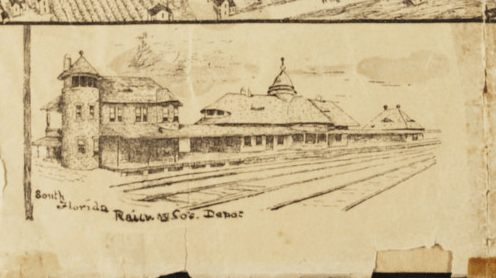
From 1890 Map of Orlando: Line Drawing of Church Street Train Depot

From 1890 Map of Orlando: Line Drawing of Church Street Train Depot

From an 1890 map of Orlando, a drawing of the train depot at Church Street. The station was brand new and serviced the South Florida Railroad

Categories: Advertising | Tags: , , | Leave a comment

Church Street Station / A.C.L. Depot Orlando, FL

Church Station 1908 and 2031

Church Station 1908 and 2013

The Post Card

In 1908, our postcard writer, Murdy, mailed a post card from Orlando to Clara in Watertown, WI announcing, “This is where we landed.”  The writer went on to express concern the postcard was a duplicate, “I wish I could remember what kind of postals I sent you.  Am afraid you’ll duplicates… Love to all.  Murdy”

Click to read reverse

Click to read reverse

Church Street Station

Few buildings have been in Orlando longer than this train depot.  From the 1800’s when Church Street was a dirt road, through the the 1970’s and 1980’s when it was surrounded by one of Florida’s top tourist attractions, until today where it awaits the future Sunrail riding along its tracks.

In the earliest days of Orlando, the first train depot stood here as a wooden platform servicing the area’s first rail service.  The route was Orlando to Sanford.  Tickets were sold across the street in a warehouse owned by Joseph Bumby.  Bumby, one of Orlando’s early business men and citrus growers, later built Bumby Hardware across the street (in the building where Hamburger Marys is today).

Church Street Station - Forgotten in the mid 70's[Source: Flickr:alcomike43]

Church Street Station – Forgotten by the 70’s
[Source: Flickr:alcomike43]

In the late 1880’s, the depot (as pictured on the postcard above) was built for the South Florida Railroad.  This train route went as far “south” as Tampa.   The Atlantic Coast Line acquired the route in 1902.  The Church Street station was a passenger depot until 1926.  That year a new passenger station, now an Amtrak Station and still in use, was built on Sligh Boulevard.  From 1926 until 1972, this station on Church Street continued on as a ticket outlet and freight station.  By the 7o’s, the buildings to the west were mostly abandoned and the station itself was falling into disrepair.

A young businessman, Bob Snow, had success in Pensacola, FL creating a nighttime entertainment complex from derelict buildings.  He purchased many of the buildings surrounding the train station and brought the success of Rosie O’Grady’s Good Time Emporium to Orlando.    Rather than just restore old buildings — he refurbished and redefined them with a grand attention to detail.  Snow purchased antiques and furnishing from points all over the world — chandeliers reclaimed from a Boston bank, painted glass from a pub in England — to create the Church Street Station entertainment complex.

Church Street Station during its heyday

Church Street Station during its heyday

The project was a great success and brought people back into downtown Orlando.  In the 1980’s, Church Street had over 900 employees, drew almost two million people a year, and was one of the largest attractions in Florida.  A new concept at the time in which a single admission price allowed access to a variety of nightclubs, restaurants, and lounges.  A weekly TV show was even broadcast from here featuring country music headliners.   For many years, this was a nighttime favorite for tourists and locals.

Church Street Station had seen its heyday by the 1990’s.  Bob Snow had sold his interest.  Disney and Universal opened nightclub complexes and fewer tourists came downtown.  In the early 2000’s with a huge decline in attendance, Church Street Station closed its doors.

Since then, Church Street always seems to be on the verge of a comeback.  Great spaces like the Cheyenne Saloon are used for special events, and many of the other venues are now occupied by Hamburger Mary’s, Ceviche, and the Harry Buffalo.  The Amway Center and 55 West high rise apartments bring in foot traffic.  East of the tracks, Mad Cow Theater recently moved in and promising new places like craft beer spot, Eternal Tap, continue to add to the energy and nostalgia of Church Street.

The train station itself sits empty, but remains in good condition.  Just as it has for 125 years, the Church Street depot continues to sit in the midst of a growing and changing downtown Orlando.

_________
Sources:
Rails Across Dixie, A History of Passenger Trains in the American South; Jim Cox 2010
Remembering Orlando, Tales from Elvis to Disney; Joy Wallace Dickinson 2006
Orlando, A Centennial History; Eve Bacon 1975
Snow and Associates website
Flickr user: alcomike43

Tammy Wynette performing at The Cheyenne Saloon and Opera House:

Categories: Post Card Stories | Tags: , , , | 1 Comment

Blog at WordPress.com.