Working on the railroad…
Preparing for Sunrail.


Working on the railroad…
Preparing for Sunrail.
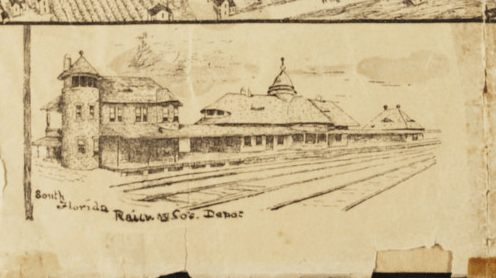
From an 1890 map of Orlando, a drawing of the train depot at Church Street. The station was brand new and serviced the South Florida Railroad

Orange County Courthouse Annex in 1960’s, and the same view today looking at Heritage Square
The Postcard
The postcard depicts the Court House Annex. The two colors of exterior tile made it look modern for the era. Across the street is a 5 cents parking lot, which is the property where the library stands today. If you’ve been downtown recently, 5 cents won’t get you 5 minutes on the meter.
Orange County Court House and Annex
The property on which the Orange County Courthouse Annex stood has been significant since Orlando’s earliest days. A log cabin on this site in 1857 served as the first courthouse. Orlando’s original city limits were set to be one mile to the north, south, east, and west of this spot.
Several courthouse came and went as the community grew. In 1892, a large red brick Victorian Style courthouse with a clock tower stood here. That Victorian style courthouse was replaced by this structure in 1959. The modern-for-its-time annex was built next to the 1927 courthouse. While the aqua exterior may have been more Miami Beach than Orlando, the building brought a contemporary edge to downtown.
On the fifth floor was a jail featuring a progressive kitchen where meals were prepared by prisoners for the 165 inmates in the facility. This is also the building where Ted Bundy’s trial was held in the 80’s.
During construction in 1959, a time capsule was buried in the courthouse. It contained artifacts from the decade such as a rubber stamp from Christmas, FL and 50 pennies. (Today that time capsule awaits its 2059 opening at the History Center).
Although the annex was constructed to last for a century, it barely lasted 40 years. Asbestos made the building unsafe. In 1989, the county moved 300 employees and 200 inmates out of the annex. Some courtrooms were temporarily moved to the Angebilt Hotel. The cost of removing the asbestos was high. It was an estimated $30 million to make it safe enough to use again. In the end, only the first three floors were cleaned up and used again while the current courthouse was under construction.
The annex was demolished and the site was converted into Orlando Heritage Park by the early 2000’s.

Heritage Square today on the site of the 1959 Courthouse Annex
Sources:
Ninth Judicial Circuit Court of Florida Orlando Sentinel, 11/26/1998, 10/25/1990
Church Station 1908 and 2013
In 1908, our postcard writer, Murdy, mailed a post card from Orlando to Clara in Watertown, WI announcing, “This is where we landed.” The writer went on to express concern the postcard was a duplicate, “I wish I could remember what kind of postals I sent you. Am afraid you’ll duplicates… Love to all. Murdy”

Click to read reverse
Church Street Station
Few buildings have been in Orlando longer than this train depot. From the 1800’s when Church Street was a dirt road, through the the 1970’s and 1980’s when it was surrounded by one of Florida’s top tourist attractions, until today where it awaits the future Sunrail riding along its tracks.
In the earliest days of Orlando, the first train depot stood here as a wooden platform servicing the area’s first rail service. The route was Orlando to Sanford. Tickets were sold across the street in a warehouse owned by Joseph Bumby. Bumby, one of Orlando’s early business men and citrus growers, later built Bumby Hardware across the street (in the building where Hamburger Marys is today).
![Church Street Station - Forgotten in the mid 70's[Source: Flickr:alcomike43]](https://orlandoretro.com/wp-content/uploads/2013/03/church-street-2.jpg)
Church Street Station – Forgotten by the 70’s
[Source: Flickr:alcomike43]
A young businessman, Bob Snow, had success in Pensacola, FL creating a nighttime entertainment complex from derelict buildings. He purchased many of the buildings surrounding the train station and brought the success of Rosie O’Grady’s Good Time Emporium to Orlando. Rather than just restore old buildings — he refurbished and redefined them with a grand attention to detail. Snow purchased antiques and furnishing from points all over the world — chandeliers reclaimed from a Boston bank, painted glass from a pub in England — to create the Church Street Station entertainment complex.

Church Street Station during its heyday
The project was a great success and brought people back into downtown Orlando. In the 1980’s, Church Street had over 900 employees, drew almost two million people a year, and was one of the largest attractions in Florida. A new concept at the time in which a single admission price allowed access to a variety of nightclubs, restaurants, and lounges. A weekly TV show was even broadcast from here featuring country music headliners. For many years, this was a nighttime favorite for tourists and locals.
Church Street Station had seen its heyday by the 1990’s. Bob Snow had sold his interest. Disney and Universal opened nightclub complexes and fewer tourists came downtown. In the early 2000’s with a huge decline in attendance, Church Street Station closed its doors.
Since then, Church Street always seems to be on the verge of a comeback. Great spaces like the Cheyenne Saloon are used for special events, and many of the other venues are now occupied by Hamburger Mary’s, Ceviche, and the Harry Buffalo. The Amway Center and 55 West high rise apartments bring in foot traffic. East of the tracks, Mad Cow Theater recently moved in and promising new places like craft beer spot, Eternal Tap, continue to add to the energy and nostalgia of Church Street.
The train station itself sits empty, but remains in good condition. Just as it has for 125 years, the Church Street depot continues to sit in the midst of a growing and changing downtown Orlando.
Tammy Wynette performing at The Cheyenne Saloon and Opera House:

An ad for a Hupmobile Dealer from the 1921 Orlando Business Directory. At 209 S Orange Ave, this would have been around the Church Street intersection.
And what is a Hupmobile?


Click to read the reverse
The Postcard
In 1933 (or maybe it reads ’38), our postcard writers were in Orlando to attend a graduation at Rollins College. They stayed a few nights at the top floor of the Angebilt Hotel. The afternoon before the graduation they wrote the postcard to Kay in South Euclid, OH about their stay. It was signed “oceans of love, Daddy and Mary.”
Angebilt Hotel

The Angebilt is a great place to start this blog about Orlando’s past. An Orange Avenue landmark for 90 years, and for decades the premier hotel in Orlando. When it opened in 1923, it was a near skyscraper as the tallest building in the city at 11 floors.
A sign in the front advertised the 10th floor dining room as “The Height of Hospitality.” Aside from 250 rooms, guests could enjoy a beauty salon/barber shop, a drug store, and a cocktail lounge. With no other buildings as tall to block the view, the roof-top sky deck provided great views of Lake Eola and the area. The hotel hosted the University Club and at one time housed two radio stations.
Great Americans walked through the lobby doors during its long history. Henry Ford, Harvey Firestone, and Thomas Edison, all stayed once at the Angebilt during a trip to Edison’s home in Fort Myers. In the early 60’s, Joan Crawford was on the board of Pepsi and attended a reception held in the ballroom for the soda company.
The hotel faced hardship at times. The early owner filed bankruptcy within months of the hotel opening and it changed hands within its first year. Decades later in the forties, a hurricane destroyed the top floor ballroom. By the ’70s, the elegance was long gone and it attracted a less upscale clientele.
In the 1990’s with the hotel no longer in operation, the building was converted into a temporary courthouse. This was while the new Orange County Courthouse was under construction.
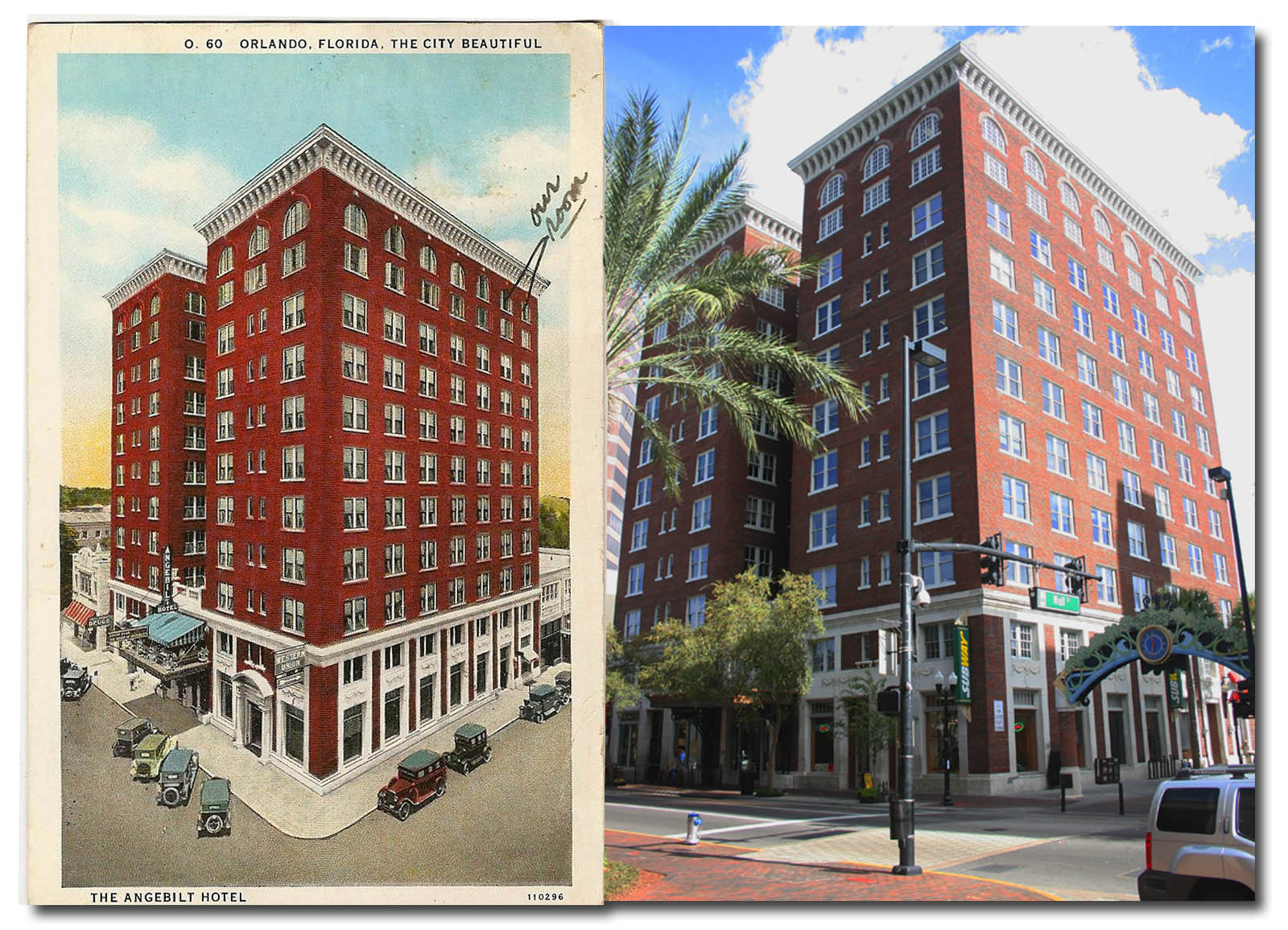
The Angebilt Hotel in the 1930’s and the building today.
What’s There Today
The Angebilt still stands on Orange Avenue looking much like it did 90 years ago. The decorative “A” can still be found on the entry way. The lobby has been restored to its original style and is often decorated with fresh flowers. CoLab Orlando, which provides shared office space for creative and technical professionals, is based here. Two business on the ground floor generate business at lunch and in the evenings. Finnhenry’s is on one corner and a Subway on the other.
Although it would be more appealing to see something other than a sandwich chain at the base, The Angebilt is a great example of a landmark building being redefined to keep its place in the community and remain part of its heritage.

Sources:
A Guide to Historic Orlando; Steve Rajtar, The History Press, 2006
Orlando Magazine, March 2007


 orlando retro