Monthly Archives: September 2013

Three Orlando Businesses in Vintage Publix Buildings

The first Publix Supermarket in Winter Haven, FL.   Similar stylings can be seen on the Orlando buildings listed below.

The first Publix Supermarket in Winter Haven, FL. Similar stylings can be seen on the Orlando buildings listed below.

Publix

Shopping has been a pleasure at Publix for Orlando residents since the 30’s. George Jenkins started his company in nearby Winter Haven in 1930.  Despite the depression, his stores were successful businesses and Publix quickly grew throughout Central Florida.  In 1940, he created Florida’s first supermarket.  As described on Publix’s website, it was a “‘food palace’ of marble, glass and stucco, and equipped it with innovations never seen before in a grocery store. Air conditioning. Fluorescent lighting. Electric-eye doors. Frozen food cases. Piped-in music. Eight-foot-wide aisles. Open dairy cases designed to Mr. George’s specifications. In-store donut and flower shops. People traveled from miles to shop there, and Publix prospered.”

Today there are over 1000 Publix locations and dozens within Orlando.   As new locations are added, the old buildings are sometimes left behind.   The Publix in College Park has operated on the same site (though the building has been updated) for about 60 years, but most of the old Publix buildings have been torn down or repurposed.

Here are three existing buildings that represent vintage Publix supermarkets that now house other Orlando businesses.

Dexter's of Thornton Park Now a popular brunch spot, this building was constructed in 1936 and the first Publix in the area.

Dexter’s of Thornton Park

Now a popular brunch spot, this building was constructed in 1936 and the first Publix in the area.

First Class Dry Cleaners Once the site of a large Publix Supermarket, today this Orange Blossom Trail building is a dry cleaner.

First Class Dry Cleaners

Once the site of a large Publix Supermarket, today this Orange Blossom Trail building is a dry cleaner.

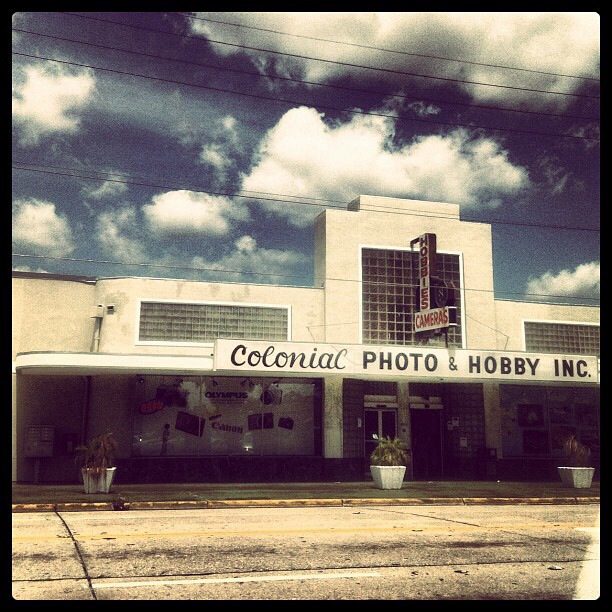
Colonial Photo and Hobby A local icon in itself as a photo and hobby shop in what was once a Publix Supermarket.

Colonial Photo and Hobby

A local icon in itself as a photo and hobby shop in what was once a Publix Supermarket.

An Orlando Publix ad from the 1947 Morning Sentinel Bacon at 56 cents a pound!

An Orlando Publix ad from the 1947 Morning Sentinel
Bacon at 56 cents a pound!

Categories: Retro Lists | 1 Comment

The Grand Theatre

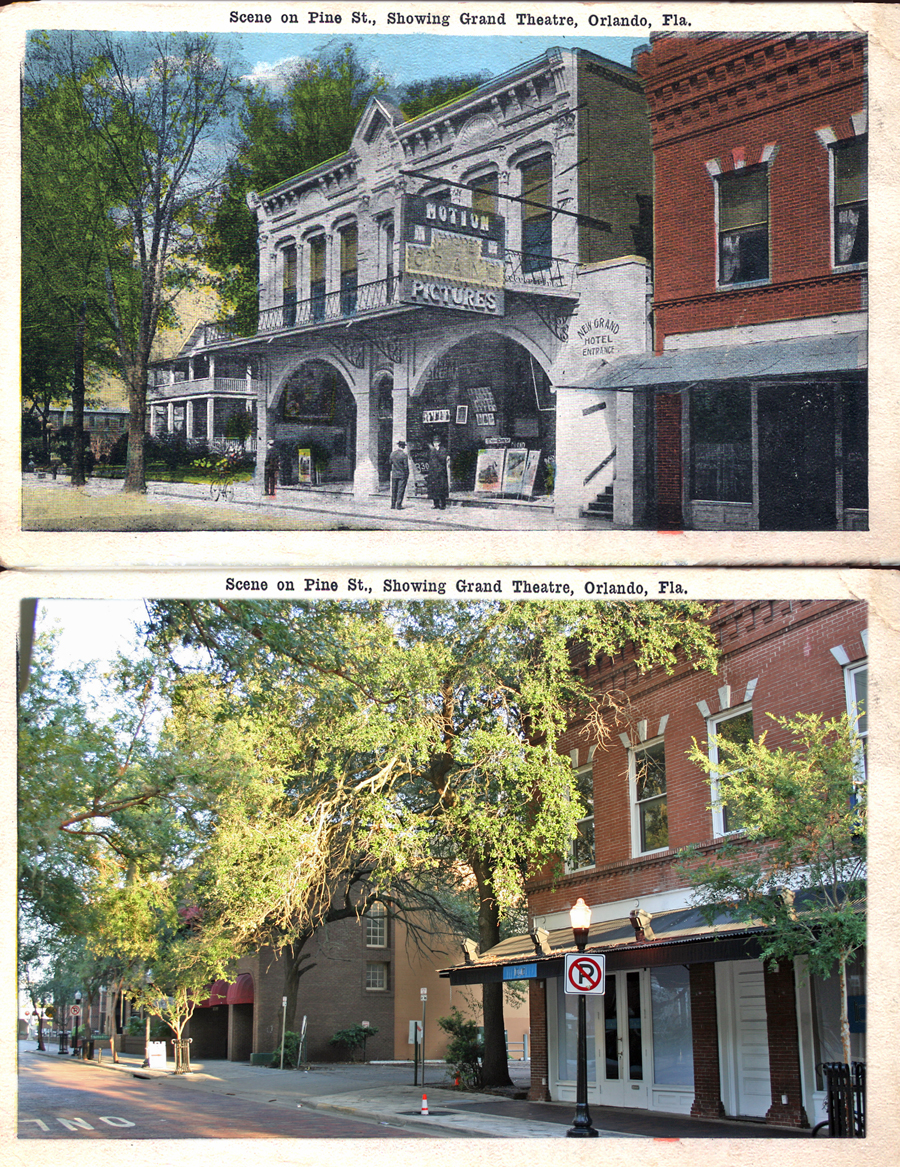
Top: Grand Theatre - circa 1915 Bottom: The site today is mostly a parking lot - 2013

Top: Grand Theatre circa 1915
Bottom: Mostly a Parking Lot Today 2013

The Grand Theatre

Orlando residents have enjoyed attending live performances and movies in the comfort of a theater since 1884. The first major theatre was an opera house downtown. It was housed in a large wooden frame building with a stage lit by kerosene lamps (This was roughly where the Solaire high-rise apartment building is today).   The Grand Theatre came along in 1912. By this time, Orlando had other theaters, but the growing popularity of motion pictures seemed like a good opportunity for Orlando businessman, Colonel T.J. Watkins. He began constructing the Grand Theatre and Grand Hotel at the Nashville Block located between Central and Pine.

The Grand Theatre opened as a silent movie house, when motion pictures were a draw even without sound. The film projectors were hand-cranked.  Musicians played music live for the films. Popular musicians were even billed along with the movie. A few years after opening, the theatre was one of the first locally to use a photoplayer, which was a sort of automated orchestra for silent films.   In 1915, the theatre introduced a new policy that included partitioning half of the balcony for use by African-American film goers.
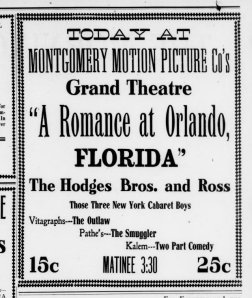
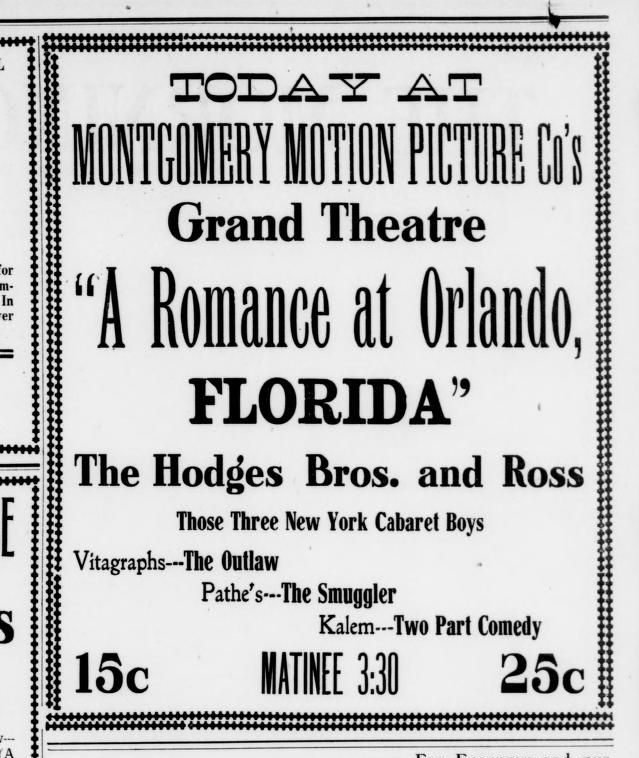
"A Romance at Orlando"

“A Romance at Orlando”

“Romance at Orlando”

Today Orlando is better known for movie studios than movies filmed here. Although Universal Studios and Disney’s Hollywood Studios are mostly theme parks, some movies have been filmed here. The list includes Parenthood (1989), The Waterboy (1998), and admit it or not Larry the Cable Guy: Health Inspector (2006).  When did we get our start in the movie business?  In 1914 with the silent film Romance in Orlando.

Filming made front page news of The Morning Sentinel on December 11, 1913.  Scenes were filmed around Orlando at businesses and the home of city pioneer Braxton Beacham (You might recognize the name from the Beacham Theatre).   The newspaper described a scene in the moving involving a political rally and being filmed at the bandstand.  It mentioned when the camera panned around who among the locals could be seen in the crowd.  The story noted screen time was given to Fire Chief William Dean, City Alderman W.P. Watson, and in terms that seem crass today, “even the old negro Garey, whom everybody knows.”

Romance at Orlando opened at The Grand Theatre January 13 & 14, 1914 just one month after filming.  The Grand seated about 750 people and every seat must have been filled as 3000 people watched the film on those two days.  The Morning Sentinel describing the film as a, “pleasing picture made popular by the appearance of local characters.”

Astor Theatre

Silent films gave way to movies with sound.  Gone With The Wind was such a hit after its 1939 release that The Grand was sold out for two months straight.  In the decade to follow the building began to age and was in need of updating in order to stay relevant.   In 1954, the theatre was completely redecorated, refurbished, and rebranded as the Astor Theatre.  Newer technology — including a sound system and air conditioning — were added.   Two rows of seats were removed from the back to make room for concessions and the women’s room was outfitted with a powder bar.   Now, the ladies could freshen up during intermission.

Ushers await outside the Grand Theatre - Around 1930

Ushers await outside the Grand Theatre – Around 1930

The new name and remodel were not enough to save the Grand.  The screen went dark in the early sixties and the theatre was torn down about 1965.  In the post card scene above, the brick building seen to the right of the theatre still stands (where Backbooth bar is currently located).  Nothing is really left of the Grand Theatre today, but memories of the silver screens golden age.

Categories: Post Card Stories | Tags: , , , | 5 Comments

The Other Lake Eola Fountain

Sperry Fountain 1940's and 2013

Sperry Fountain
1940’s and 2013

The Other Lake Eola Fountain

We all know the fountain in the middle of Lake Eola — the one surrounded by swan boats and serves as a city icon for Orlando.  That fountain is the Linton E. Allen Memorial Fountain, better known as the Centennial Fountain.  However this post is not about that fountain, this is about its less popular sister, the Sperry Fountain.    Not much attention is directed toward the Sperry Fountain, which has been part of the scenery at Lake Eola for a century.

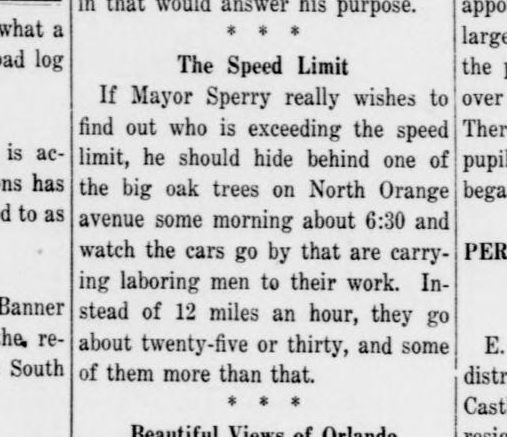
An Orlandoan gives Mayor Sperry advice on cars speeding down Orange Ave. Morning Sentinel - Jan 9 1914

An Orlandoan gives Mayor Sperry advice on cars speeding down Orange Ave.
Morning Sentinel – Jan 9 1914

E. F. Sperry was one of Orlando’s pioneers.  Originally from Connecticut, he moved to Orlando in 1885 after vacationing in the area.   Within a year of moving here, he co-founded the South Florida Foundry and Machine Works.  Providing metal works for iron stairs, balconies, trains, and fencing, it grew into one of Orlando’s earliest industries.  Mr. Sperry did well for himself.  He had a home on East Pine Street and owned property that included the southwest portion of Lake Eola.

When he later sold his interest in the machine works, he remained active in the community.  Sperry served on the city commission, the park commission, the Orlando Citrus Exchange (as president), and was a founding member of the First Unitarian Church of Orlando when it started in 1912.  A progressive man, Sperry was the first president of the Men’s Equal Suffrage League, which worked to help woman gain the right to vote.

His civic involvement led to his election as mayor in 1914.  Around this time he donated his Lake Eola land to the city.  His property completed the shoreline for our city’s most famous park.  (Pioneers Jake Summerlin and J. P. Mussellwhite contributed the rest of property to the city.)   Sperry also provided the $2000 for the fountain that bears his name.

Sperry fountain in the 1960s

Sperry fountain in the 1960s

Sperry never finished his first mayoral term and suddenly passed away in 1916.  His legacy continued when his successor, Mayor James L. Giles, continued the fight for women to gain voting rights.  Less than three years after Sperry’s death, the City Council voted to amend the city charter allowing women to vote in Orlando.

Although the original fountain has been replaced, March 2014 marked 100 years of operation for Mayor Sperry’s fountain.

___________________

  • Orlando Sentinel, 9/8/1996
  • From Florida Sand to “The City Beautiful”, E.H. Gore 1949
  • Orlando, A Centennial History, Eve Bacon 1975
Categories: Post Card Stories | Tags: , | 7 Comments

Blog at WordPress.com.